Total Pageviews

Thursday, October 31, 2013

The Satanic Phenomenon: Medieval Representations of Satan

de bene esse: literally, of well-being, morally acceptable but subject to future validation or exception


 The Satanic Phenomenon: Medieval Representations of Satan
Matos, Morgan A.
Masters of Liberal Studies Theses, Rollins College, Paper 28, July (2011)
Abstract: This project deals with the one and only character of Satan, revealing him through the eyes of the medieval world. The ever-evolving, interconnectedness of culture, religion, and superstition make for a truly unique theatrical experience in the middle ages. With limited understanding and access to scripture, medieval Christians generated a blended belief system, in order to make sense of the metaphysical world, which manifests itself in medieval drama‟s representations of Satan. While the medieval character of Satan upholds many of the Church‟s teachings about his nature and purpose, he takes on a new persona when left to the dramatic interpretation of the laity, as opposed to the interpretation of the monastic writer, scholar, or prophetic poet. The literary work of Dante and Milton deliver valuable satanic representations, arguably trumping all others, but something essential is lacking there, when compared to the Satan found on the medieval stage, who now resides not in hell, but in the shadow of Dante and Milton’s Satan.
Introduction: When one begins to research medieval drama, art, and culture a familiar figure begins to pop up in multiple places. He can be seen in Hildegard’s Scivias, a series of painted tiles that portray apocalyptic scenes, along with other religious art adorning cathedral walls. His names can be heard in folklore, urban legends, and superstitions passed down through generations and spread from one town to the next. The medieval era brings us a character catapulted from the position of a familiar name to complete phenomenon, stealing scenes, causing mayhem in the streets, and making sin something to laugh about, while in the same breath making folks fearful for their soul. This project deals with the one and only character of Satan, revealing him through the eyes of the medieval world.
The ever-evolving, interconnectedness of culture, religion, and superstition make for a truly unique theatrical experience in the middle ages. With limited understanding and access to scripture, medieval Christians generated a blended belief system, in order to make sense of the metaphysical world, which manifests itself in medieval drama’s representations of Satan. While the medieval character of Satan upholds many of the Church’s teachings about his nature and purpose, he takes on a new persona when left to the dramatic interpretation of the laity, as opposed to the interpretation of the monastic writer, scholar, or prophetic poet. The literary work of Dante and Milton deliver valuable satanic representations, arguably trumping all others, but something essential is lacking there, when compared to the Satan found on the medieval stage, who now resides not in hell, but in the shadow of Dante and Milton’s Satan.

10 old letter-writing tips

de bene esse: literally, of well-being, morally acceptable but subject to future validation or exception


(clockwise from top left): sealed letter and quill; hands on computer keyboard; hand writing letter; hand posting postbox; paper clip
Before email, letter-writing guides were best sellers, the faddy self-help books of their day. There are still many things that we can learn from them before pressing "send", says Simon Garfield.
1. Keep it brief, make it simple. This advice first appeared in a Latin tract somewhere between the 4th Century BC and 4th Century AD. A letter should be "restricted", it advised. "Those that are too long, not to mention too inflated in style, are not in any true sense letters at all but treatises." Correspondents were told to be both graceful and plain. "A letter's aim is to express friendship briefly and set out a simple subject in simple terms. The man who utters sententious maxims and exhortations seems to be no longer chatting in a letter but preaching from the pulpit."
2. Write as you speak. This advice, much favoured by Jane Austen, is believed to have been initially promoted by Aristotle in about 360BC. His precise instructions do not survive, but Artemon, the editor of Aristotle's letters, maintained that "a letter should be written in the same manner as a dialogue".
AristotleAristotle carrying the morning's post
3. Don't be afraid to grovel. Want to say thanks for dinner? Look to the writing manual by Hugh of Bologna from the 12th Century. One of Europe's epistolary masters, Hugh's compliments knew no ceiling. In a letter to another scribe, he observes how, under his guidance, "the uneducated are immediately cultivated, the stutterers are immediately eloquent, the dull-witted are immediately enlightened, the twisted are immediately made straight". May also do the trick when applying for a job or a loan.


4. Be spontaneous, be free. Progressive French 16th Century essayist Michel de Montaigne suggested that formality spelled death to authentic correspondence. He mistrusted letters that "have no other substance than a fine contexture of courteous words". Far better to be spontaneous and not think too much. "The first word begets the second, and so to the end," he wrote. Montaigne really would have loved email, not least our growing tendency to dispense with formal greetings and endings. "The letters of this age consist more in fine edges and prefaces than in matter," he argued. And for the closing niceties, "I would with all my heart transfer it to another hand to add those long harangues, offers, and prayers that we place at the bottom, and should be glad that some new custom would discharge us of that trouble."

Start Quote

It is a very great incivilitie not to answer all the letters we do receive, except they come from our servants or very mean persons”
Philip, Second Earl of Chesterfield
5. Tell it like it is. In the guide Cupids Messenger of 1629, the anonymous author told his readers how to write to an unfaithful partner. There was really no point being polite. Far better to be bilious and vengeful. "Leprosie compared to thee is all health... neither thy bodie nor thy soule are free from the disease of shame and disgrace of the world." Try this ancient advice first, and only then revert to the more modern solution of a letter from a solicitor.
6. Write back swiftly, but carefully. In 1686, Philip, second Earl of Chesterfield, wrote a book of instruction for his eldest daughter. Some of it concerned the layout of a letter ("If you write to a Queen, begin your first line within three fingers breadth of the bottom of the paper"), but there was also advice we may heed today. He advised his daughter to carefully re-read what she had written before sending it, checking her spelling with a dictionary and making sure not to repeat words. But above all be prompt. "It is a very great incivilitie not to answer all the letters we do receive, except they come from our servants or very mean persons."
Dictionary

Start Quote

Take out a lot of the vinegar and pepper, and put in honey instead”
Lewis Carroll
7. Emotional blackmail may work with your parents. The Ladies Complete Letter-Writer of 1763 offered "polite and improving" advice on all matters "that usually interest the Fair Sex". There were template letters about the lasting impact of scandal and the dangers of over-flirtatious behaviour, and details of how to write to a woman who had lost her beauty to smallpox. But within the 275 pages there was also something that may be emailed today (albeit with slightly modified language) to an overbearing parent determined to match-make. "Punish me by any other means provoked authority can invent," an unidentified daughter pleads with her mother. "Condemn me to pass the whole remainder of my days in lonely solitude; shut me from all society, or banish me where only lions and tigers dwell. Fate cannot reach me in any shape so horrid as the embraces of Andrugio."
Victorian postboxThink before you post
8. Be more polite than you really want to be. Lewis Carroll loved letter-writing so much that in 1888 he patented something called The Wonderland, a special case with a pocket to house every denomination of postage stamp. You bought the case and you got a free booklet entitled Eight or Nine Wise Words About Letter-Writing, some of it concerned with not missing the last post. But there was also something we can use today - advice on showing restraint. Notwithstanding rule five - tell it like it is - Carroll warned his readers to think very carefully before getting involved in a Trollopian war. "If you have written anything that may offend, put the letter aside for a day and then read it as if you were the recipient," he wrote. "This will often lead to your writing it all over again, taking out a lot of the vinegar and pepper, and putting in honey instead." Carroll's other rules:
  • if your correspondent makes a severe remark, either ignore it or soften your response
  • if your friend is friendly, make your reply ever friendlier
9. Don't forget the paper clip. Carroll had one more piece of wisdom, as applicable now as 125 years ago. If you write that you're enclosing a cheque or someone else's letter, "leave off writing for a moment - go and get the document referred to - and put it into the envelope. Otherwise, you are pretty certain to find it lying about, after the post has gone!" For "cheque" read "email attachment".
Charles Dickens writing at deskDickens: "Folios of trash are lavished on bosom friends"
10. The young get all the blame. In All The Year Round, the Victorian journal "conducted" by Charles Dickens, a contributor wrote a letter-writing guide that contained the one nugget common to almost all the guides that had preceded it - write legibly. But what of those who can write but don't? "This is more generally the fault of young people, and arises chiefly from thoughtless selfishness. Their thoughts and their time are engrossed with their own pleasures and pursuits. It is more amusing and interesting to write to young people of their own age than to write duty letters to parents and relatives." Do these terrible people not write at all? "A shabby, ill-considered, stilted letter is written at wide intervals to those whose whole life has been spent in their service, while folios of trash are lavished on bosom friends to whom they owe no duty whatsoever." Texting was only a century away…
Arm holding fish
PS If all else fails, send fish. Key To English Letter Writing was a guide that could have been written by Douglas Adams. But it appeared in 1938 in China, and its authors were Chen Kwan Yi and Whang Shih. Unlike Anglo-American guides, its letter templates did not consider how best to address a duchess. Instead, the examples were both more mundane and, conceptually, more profound. How, for example, should one write to a newlywed? Like this: "I have heard from Mr B that you were married to Miss C last Wednesday. I beg your acceptance of the accompanying fish as a trifling token of my affection." And when that marriage proves fruitful? "Allow me to congratulate you on the birth of a child in your family. I beg you will accept the accompanying basket of mixed fish which I send you in celebration of the happy event." Would a promotion, perhaps in the legal profession, also yield a fish gift? Sadly not. "Sir, I learn with pleasure that you have been admitted to the bar and have established yourself in private chambers. Please accept the accompanying bicycle as a slight token of my wishes for your future success."
This gifting advice has a modern equivalent in the form of dreaded e-cards and text emoticons. Rather less satisfying than a good piece of cod or a 12-speed though.

Five storms that shaped history

de bene esse: literally, of well-being, morally acceptable but subject to future validation or exception


Nazi retreat from Moscow in 1941 in quagmire of snow and mud
The current bad weather in the south of the UK prompted a discussion about moments in history shaped by storms. Historian Dan Snow recalls five of the most significant.
1. In 480 BC the emperor of the mighty Persian Empire, Xerxes, led a massive combined force to conquer the troublesome Greeks. More than a third of his fleet was smashed on Greece's rocky eastern shores by a vicious summer gale. His weakened fleet was then routed by the Greeks in one of history's most important sea battles, Salamis. Democracy was saved and a Greek golden age dawned.
2. The Mongol Empire stretched from the Pacific to the Black Sea. In 1274 and 1281 its ruler, Kublai Khan, launched invasions of Japan, countless ships carrying vast numbers of men, bristling with the latest gunpowder weapons. Both times typhoons swept in and sank the Mongol fleets. Priests named the typhoons kamikaze, meaning "divine wind". Japan's independence was assured, as was its powerful sense of indestructibility.

3. In July 1788 the French harvest was obliterated by a three-day hailstorm. The hailstones were apparently the size of "quart bottles" and took days to melt. This followed a run of bad harvests and already high bread prices shot up even further. The people's rage was directed at King Louis XVI's government and a year later the Revolution started in earnest. The Ancien Regime was swept away, unleashing powerful forces that continue to shape the modern world.
4. Britain has been saved from invasion by the weather so often that people used to insist that "God is an Englishman". In 1744 the brilliant French general, de Saxe, was poised to cross the Channel, Bonnie Prince Charlie on standby to be installed as a French puppet, but in February the fleet of naval and transport vessels was sunk and scattered by a fierce storm. France abandoned her plans, Britain's rise to global domination continued uninterrupted.
5. In October 1941 Hitler unleashed a giant attack on Moscow. Capture of Stalin's capital might have won the war for Germany. Atrocious weather mired the Germans first in impassable mud and then in horrific, record-breaking low temperatures and snow storms. Millions were killed and wounded, the Germans were fought to a standstill within sight of the Kremlin. The Soviet Union was saved, Hitler's best chance of winning WWII was shattered.
Follow @BBCNewsMagazine 

Who was the real Cleopatra?

de bene esse: literally, of well-being, morally acceptable but subject to future validation or exception

Cleopatra VII, the last pharaoh of Ancient Egypt, is history’s most famous queen – and the most alluring. Even more than 2,000 years after her death, her persona continues to inspire books, plays, movies and museum shows – including the new Cleopatra: Rome and the Magic of Egypt
Egyptian ancient papyrus
The exhibition, which runs until 2 February at Rome’s Chiostro del Bramante, brings 180 pieces from around the world to evoke Cleopatra’s turbulent, fascinating era. The works, which include sculptures and bracelets, frescoes and funerary urns, hail from collections as esteemed as the Louvre in Paris, Kunsthistorisches in Vienna, and British Museumin London.

However, this is not an exhibition that delves into how Cleopatra has been imagined (and romanticised and vilified) in the modern period. The show seeks, instead, to contextualise her reign within her own, ancient era. And that’s what makes it unique.

Viewers learn how Romans fantasised about Egypt’s verdant lands. A mosaic from the 1st Century BC stretches almost the length of the space, showing a Nile River scene of fish, ducks, crocodiles and boats, all exquisitely elaborated in tiny glass tesserae; while a marble sculpture from the same period depicts an acrobat doing a handstand on a crocodile’s back.

Another section explores how Cleopatra’s stay in Rome, from 46 to 44BC, sparked Egyptomania in the capital, showing artefacts such as a fresco of sphinxes from a Pompeiian villa and a gold bracelet in the shape of Cleopatra’s icon, the serpent.

The show seems to have been curated on the assumption that most people already know the broad outlines of her life: how she seduced Caesar and convinced him to back her claim to the throne; or how she later charmed Roman triumvir Mark Anthony and was defeated alongside him in the fateful Battle of Actium of 31BC. After all, those details have been shared often enough, starting not with Elizabeth Taylor (1963), Shakespeare (1623) or even Plutarch (1st Century AD).

Instead, the exhibit shows viewers the kind of objects she herself would have seen and the art that she herself inspired. That might not be as dramatic as the image of Cleopatra clasping an asp to her breast. But for those curious about her life and times, it is every bit as fascinating.

Amanda Ruggeri is the Rome Localite for BBC Travel. She also writesrevealedrome.com.

Ancient Faces

de bene esse: literally, of well-being, morally acceptable but subject to future validation or exception


 Original: http://www.ancientfaces.com/photo/halloween-bicycle/1252639/

WWII mystery

de bene esse: literally, of well-being, morally acceptable but subject to future validation or exception

It appears a major WWII mystery involving a lost Nazi has been solved:

http://huff.to/1gf4Kvh
Photo credit: Paul Popper/Popperfoto/Getty Images


VMAs 1999

de bene esse: literally, of well-being, morally acceptable but subject to future validation or exception


It's 1999 all over again! Miley Cyrus channeled L'il Kim's iconic VMA look — did the rapper approve?

Click to see what Kim tweeted about Miley's getup —>http://bit.ly/HrOE2J


1920's Charlotte Home

de bene esse: literally, of well-being, morally acceptable but subject to future validation or exception

Dream House Alert: See how this traditional 1920's Charlotte home was brought back to life. Plus, we'll show you how to get the look!http://bit.ly/1aXcAm5


Tuesday, October 29, 2013

Lou Reed

de bene esse: literally, of well-being, morally acceptable but subject to future validation or exception

Lou Reed and The Velvet Underground in pictures

Mystics, Demoniacs, and the Physiology of Spirit Possession in Medieval Europe

de bene esse: literally, of well-being, morally acceptable but subject to future validation or exception


 Mystics, Demoniacs, and the Physiology of Spirit Possession in Medieval Europe
By Nancy Caciola
Comparative Studies in Society and History, Vol.42 (2000)
Introduction: In the late thirteenth century, Ida of Louvain scandalized her community. The daughter of a prosperous wine merchant, Ida already had refused marriage and become a recluse in a small cell within her parents’ home. One day, however, it seemed that she went mad. Casting aside even the simple clothes she now wore, Ida wrapped herself in a dirty rag and draped a mat over her shoulders for warmth. Aggressively seeking out the most crowded plazas and market places, she preened and “strutted about if mad or a fool, offering a monstrous spectacle of herself to the people.” Townspeople murmured that Ida was in a frenzy, out of her mind; eventually she was tied up to prevent her from harming herself or others.
What compelled Ida to act in this way? If we believe her hagiographer’s testimony, it was a divine revelation. According to Ida’s vita, her radical behavior was traceable to a vision she had just received, the first of many to come. In Ida’s vision, a pauper approached her recluse’s cell and stood before her face; he then reached out his hands and peeled back the skin of her chest, revealing her heart. The pauper climbed inside Ida’s heart and took up residence there, enjoying her “hospitality.” This is why Ida suddenly conceived a frenzy for such an abject—and visible—kind of poverty: she was divinely possessed, inhabited by the poor Christ.
The tale unveils a profound tension in the history of religious laywomen in the later Middle Ages. Whereas Ida and her hagiographer considered her state to be one of internal possession by the divine spirit, outside observers considered her “insane and frenetic,” a malady that was frequently attributed to demonic possession. Indeed, her external symptoms of dementia, frenzy, trances, convulsions, and episodes of strange bleeding precisely mirrored the behaviors characteristically reported of demoniacs at this time. Nor was Ida alone in being the object of such suspicions: accusations of demonic possession were quite a common response to women claiming divine inspiration in the later Middle Ages. Medieval communities struggled mightily over how to decide whether an inspired woman was possessed by the Holy Spirit or an unclean spirit. Although (as I shall argue below) Ida’s vision of the pauper entering her heart might have suggested a beneficent interpretation of her behaviors to a medieval audience, ultimately this vision was internal and private, hence unverifiable. From the external vantage point of the observer, Ida’s behavior appeared pointless and disordered. Parading through the plazas while proudly modeling rags was taken as an “in-your-face” gesture by Ida’s contemporaries, an indication that something was deeply wrong with her, rather than a sign of divine illumination. As I will demonstrate, this very same ambivalence of reception characterizes the careers of many women whose names populate the pages of recent monographs and articles about medieval feminine piety. Such women were frequently viewed with deep suspicion, even repugnance, by their surrounding community, the ecclesiastical hierarchy, or both.

Haile Selassie

de bene esse: literally, of well-being, morally acceptable but subject to future validation or exception


Ancient Warning

de bene esse: literally, of well-being, morally acceptable but subject to future validation or exception

Does the 9,000-year-old painting -- found on a wall buried in the ancient Turkish settlement of Çatalhöyük -- show a village in front of an erupting volcano? Researchers now believe, through the use of mineral dating and geochemical tests, that the volcano shown in the painting is the nearby Mt. Hasan, found 70 miles from the settlement site.

On this day in history

de bene esse: literally, of well-being, morally acceptable but subject to future validation or exception


On this day in history, 29th October...
1532 - Henry VIII accompanied Francis I to the border between English Calais and France to bid farewell to him.
1586 - Four days after a commission had found Mary, Queen of Scots guilty of conspiring to assassinate Elizabeth I, Parliament met to discuss Mary’s fate. They decided that they should petition the Queen for Mary’s execution. See http://www.elizabethfiles.com/mary-queen-of-scots-tragic-heroine/4443/
1605 - Death of George Clifford, 3rd Earl of Cumberland, courtier and naval commander, at the duchy house, near the Savoy in London. He was buried in the family vault in Holy Trinity Church, Skipton, near Skipton Castle. Clifford was Elizabeth I's second champion. He commanded a ship in the Anglo-Spanish War, and is known for capturing Fort San Felipe del Morro in San Juan, Puerto Rico, in 1598. Elizabeth I nicknamed him her "rogue".

Mary Queen of Scots – Tragic Heroine?

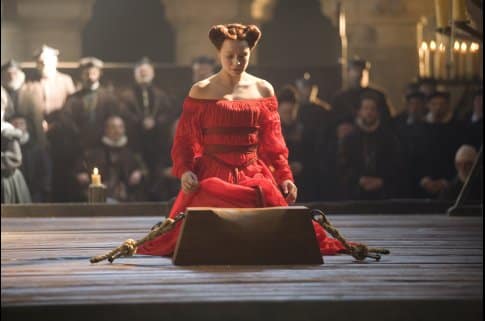
Samantha Morton as Mary Queen of Scots
On this day in history, 29th October 1586, four days after a commission had found Mary Queen of Scots guilty of conspiring to assassinate Elizabeth I, Parliament met to discuss her fate. It was decided that Elizabeth should be petitioned to execute Mary.
In my previous article on Mary Queen of Scots, “The Trial of Mary Queen of Scots”, I told of how Elizabeth did not sign Mary’s death warrant until the 1st February 1587 and we know that she gave orders for it not to be sent to Fotheringhay until she said so. It is clear that Elizabeth was struggling with taking such action against a fellow queen, an anointed sovereign, and a woman with Tudor blood. The idea of regicide horrified her but her Parliament were calling for action and a strong monarch always acts against those who conspire to dethrone and assassinate them. It surely would have been a sign of weakness if Elizabeth had let Mary go on plotting against her.
It seems from Elizabeth’s actions – signing the death warrant but not sending it, asking Paulet to kill Mary under the Bond of association – that she was trying to deal with Mary without taking any responsibility for what happened. As John Guy says, “She had carefully contrived things so that she would win whatever happened. If Mary was killed under the Bond of Association, Elizabeth could disclaim responsibility. If Cecil covertly sealed the warrant and sent it to Fotheringhay behind her back, she could claim she had been the victim of a court conspiracy.” But we cannot know for sure what was going through Elizabeth’s mind at that time. Elizabeth was caught between a rock and a hard place, as Alison Weir describes:-
“If she signed the warrant she would be setting a precedent for condemning an anointed queen to death, and would also be spilling the blood of her kinswoman. To do this would court the opprobroum of the whole world, and might provoke the Catholic powers to vengeful retribution. Yet, if she showed mercy, Mary would remain the focus of Catholic plotting for the rest of her life, to the great peril of Elizabeth and her kingdom. Elizabeth knew where her duty lay, but she did no want to be responsible for Mary’s death.”1
No wonder she procrastinated! What a decision to have to make and I don’t think anyone can blame her for taking her time, for refusing to bow to Parliamentary pressure and for taking steps to distance herself from what happened in the end. What else could she do?

Mary – Tragic Heroine and Martyr?

Recently, this site has been bombarded with comments (see comments on Free Report page and my article on Mary’s trial) proclaiming Mary Queen of Scots’ innocence, protesting that she was the rightful queen of England, Scotland and France, calling Elizabeth a “Killer queen”, accusing Elizabeth of framing Mary and accusing me of romanticising Elizabeth. They were hard to take seriously when that person also thought that Mary Queen of Scots was the daughter of Mary I (!), but they did make me think about how Mary has been romanticised in the past and seen as a tragic heroine and even a Catholic martyr. Even today, she is proclaimed a martyr, not just by the commenter on this site but also the the New Advent Catholic Encylopedia who say:-
“There can be no question that she died with the charity and magnanimity of a martyr; as also that her execution was due, on the part of her enemies, to hatred of the Faith.”2
and then write of how Pope Benedict XIV would have formally declared her a martyr “if only the charges connected with the names of Darnley and Bothwell could be entirely eliminated”3.
Mary saw herself as a martyr. At her execution, on the 8th February 1587, she wore a crucifix and a black gown and as she prepared herself for her beheading she took off her gown to reveal a bodice and petticoat of scarlet, the colour of martyrdom. In her final moments she was proclaiming that she was a martyr to her faith.
However, whatever Mary thought and whatever message she was sending by her garb, I don’t believe that she was a martyr, well, not in the sense that she meant.
martyr – noun (mär-tÉ™r)
  1. a person who voluntarily suffers death as the penalty of witnessing to and refusing to renounce a religion
  2. a person who sacrifices something of great value and especially life itself for the sake of principle
  3. victim; especially : a great or constant sufferer4
Perhaps she could be seen as a martyr according to definitions 2) and 3), but she did not died for her Catholic faith, she was executed because she plotted to kill the Queen of England. Uh oh, now I’m treading on dangerous ground with those who believe she was framed. Well, I do believe that William Cecil and Sir Francis Walsingham did all they could to bring down Mary Queen of Scots, but I don’t believe that they framed her. They set a trap and she fell into it. She gave them the evidence that they were looking for and that they needed to convince Elizabeth to get rid of her once and for all.
John Guy, in his book “Mary Queen of Scots: My Heart is My Own” explains Walsingham and Cecil’s roles in the downfall of Mary Queen of Scots brilliantly:-
“the plot [Babington plot] was not in itself a ‘projection’ [using agent provocateurs to foment conspiracies that were then conveniently 'detected'] to frame her – it really existed; but rather than nipping it in the bud, Cecil’s spymaster allowed it to develop so that he could obtain the written evidence to put her on trial for her life”. Walsingham and Cecil let the plot continue so that Mary would ‘hang herself’ by getting involved and she did by replying to Babington who was conspiring to get Elizabeth assassinated by a group of ’six gentlemen’:-
‘The affairs being thus prepared and forces in readiness both without and within the realm, then shall it be time to set the six gentlemen to work taking order, upon the accomplishing of their design, I may be suddenly transported out of this place, and that all your forces in the same time be on the field to meet me in tarrying for the arrival of the foreign aid, which then must be hastened with all diligence.’ “5
John Guy comments that “Mary’s meaning is clear. She had consented to Elizabeth’s assassination and a foreign invasion. Strictly, she had not specified what the ‘work’ of the six gentlemen was to be, but the letter from Babbington to which she was replying included the graphic passage, ‘For the dispatch of the usurper, from the obedience of whom we are by the excommunication of her made free, there are six noble gentlemen, all my private friends, who for the zeal they bear to the Catholic cause and your Majesty’s service will undertake that tragical execution.’ When the two letters are read together, Mary’s complicity in the plot was undeniable.”6
Cecil and Walsingham did not frame Mary, they laid a trap and she condemned herself with her own words and actions. She was clearly giving her blessing and her support to Babington’s plot to assassinate Elizabeth. What’s more, Babington confessed and so did Mary’s secretaries.
The Babington Plot was not a one-off, it was not the only time that Mary had conspired against Elizabeth, and as early as 1568 she had approached Philip II to help her with her cause. She also never gave up on her claim to the English throne. Elizabeth spent two decades giving Mary the benefit of the doubt and sympathising with her, yet Mary carried on plotting. I just can’t see Mary as a tragic heroine or martyr and Elizabeth as a cold-blooded killer, however I look at the situation.
What do you think?
Please share your thoughts in comments below – thank you!

Notes and Sources

  1. “Elizabeth, the Queen”, Alison Weir, p375
  2. Mary Queen of Scots, New Advent Catholic Encyclopedia
  3. Ibid.
  4. Merriam-Webster
  5. My Heart is My Own: The Life of Mary Queen of Scots, John Guy, p483.
  6. Ibid.


Read more: http://www.elizabethfiles.com/mary-queen-of-scots-tragic-heroine/4443/#ixzz2jA0PRcsj

new investigation method

de bene esse: literally, of well-being, morally acceptable but subject to future validation or exception

On this day, in 1904, the St. Louis police tried a new investigation method: fingerprints! Make sure and check out the rest of today's historical first. http://hankeringforhistory.com/today-in-history-october-28th/

Colonial Williamsburg

de bene esse: literally, of well-being, morally acceptable but subject to future validation or exception

An archaeologist walks through more than 80 years of excavation in the Williamsburg Underground tour. http://bit.ly/1gXLBPQ

Tyrone Power

de bene esse: literally, of well-being, morally acceptable but subject to future validation or exception

Lady Salisbury Forgotten Prisoner in the Tower of London

de bene esse: literally, of well-being, morally acceptable but subject to future validation or exception

Of all the prisoners that are not usually mentioned I think Lady Salisbury was the most unjustly imprisoned and executed. A cousin to Queen Catherine's father, Sir Thomas Parr, Margaret was the only surviving daughter of George, Duke of Clarence (brother of Edward IV and Richard III) and Lady Isabel Neville (daughter of Lord and Lady Warwick and sister of Queen Anne).

Of those less known listed within the blog -- who do you think was the most unjustly imprisoned and/or executed (this list does not include the two wives of Henry VIII or Elizabeth Tudor)? And why?

Royal Babies

de bene esse: literally, of well-being, morally acceptable but subject to future validation or exception