Latin for "Great Charter," it was a document delineating a series of laws establishing the rights of English baronsand major land owners,which limited the absolute authority of the King of England and became the basis for the
rights of English citizens. It was signed reluctantly by King John on June 15, 1215,
at Runnymede, at a table set up in a field under a canopy and surrounded by the armed gentry. The Magna Carta was confirmed by John's
son,Henry III, and in turn by Henry's son, Edward I. As John Cowell would write four centuries later: "although
this charter consists of not above thirty seven Charters or Lawes yet it is of such extent, as all the
Law wee have, is thought in some form todepend on it." Essentially a document for the nobility, it became the basis of
individual rights as a part of the English Constitution, which is generally more custom than written documents. It is also spelled: Magna Charta.
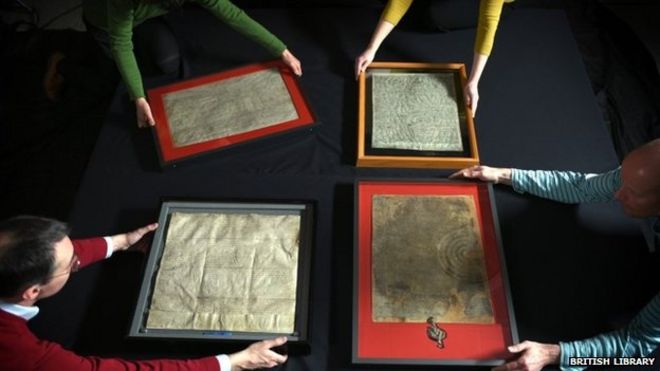
Scientists have identified the scribes who wrote two of the four original 1215 copies of the Magna Carta.
They found the copies held in Lincoln and Salisbury were written by scribes based at those cathedrals, rather than by someone working for King John. The discovery was made ahead of the 800th anniversary of the historic charter today ....read on.
No comments:
Post a Comment